
Perspectives
The New Economics of Experimentation
Daniel Shani / Nov 2026
The New Economics of Experimentation
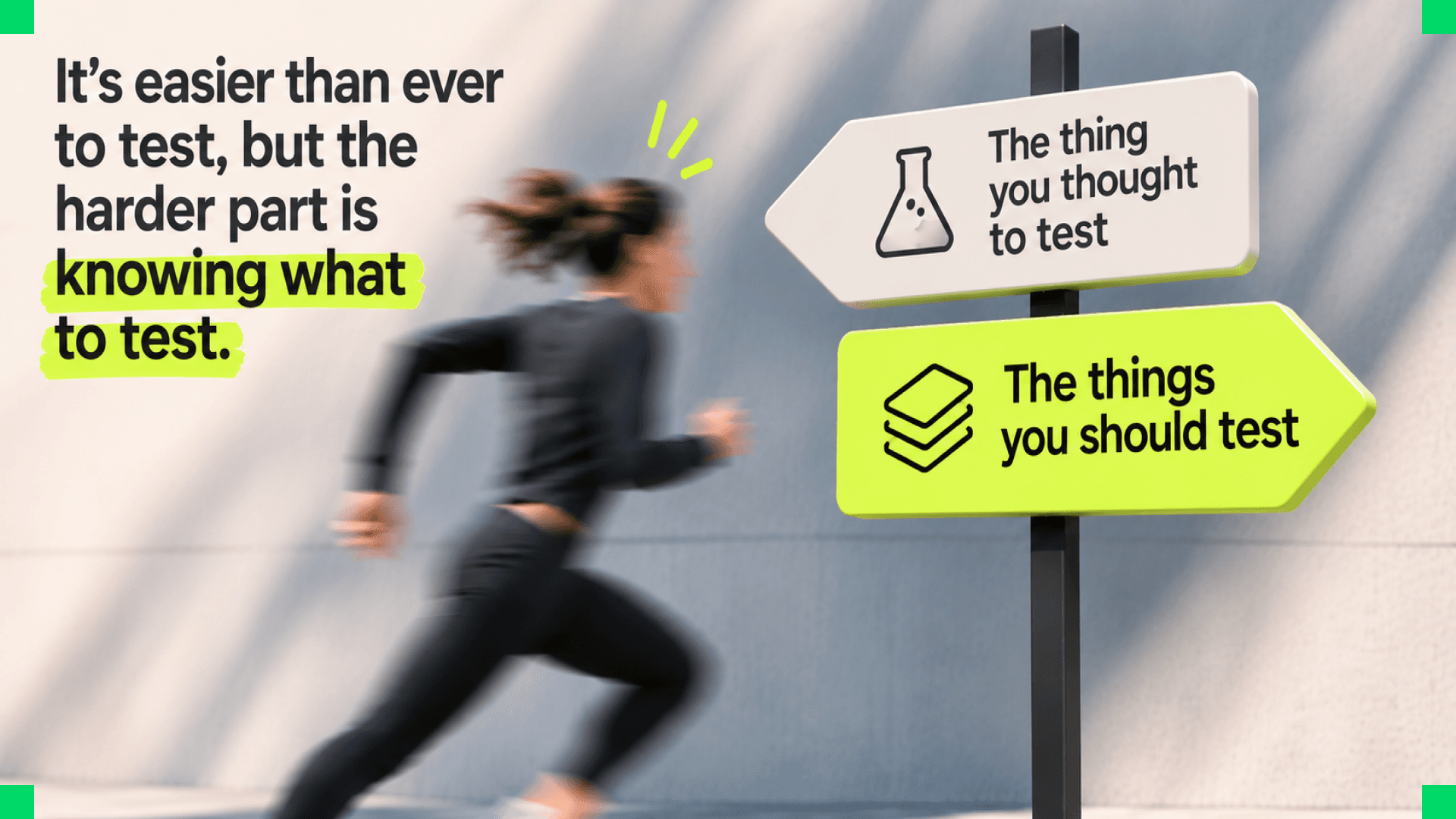
AI has made building dramatically faster. It hasn't made knowing what deserves to be built any easier.
It's a distinction that came up recently on The Cognitive Revolution podcast. In a conversation about AI-powered software development, OutSystems CEO Woodson Martin observed that deciding what to do remains the hardest question. As the cost and effort of building fall, knowing where to focus becomes even more important.
“What should I build to actually solve problems in my business? …What to do is still the hardest question… Where can I get the biggest bang for my buck? …What business process does it make sense to transform into something Agentic?”
At Co-Created, we've run thousands of experiments with more than 90 companies over 15 years. Today, most are built with the help of AI agents and workflows we’ve created. A prototype that once took months to build now takes an afternoon. We can explore more ideas, get working solutions in front of people sooner, and learn more along the way.
But just because we can build something doesn't mean we should. With tighter budgets and growing pressure to show results from AI, companies need to be more thoughtful about where they invest.
That's where experimentation comes in. Not just as a way to test ideas, but as a way to make better decisions. For us, AI makes it possible to run more experiments, often in parallel, and get working solutions in front of people faster. That means faster learning, stronger evidence, and better decisions about where to invest.
But it still takes time, attention and resources to manage and decide what’s worth doubling down on.
Two applications, one discipline.
We use experimentation in two ways:
- Growth experiments help us understand whether customers want something new, whether they'll pay for it, and whether there's a viable business behind it.
- Transformation experiments help us understand whether a new way of working is actually better than what's in place today, whether that's measured by quality, speed, cost, or reliability.
The questions are different, but the approach is much the same. Start small, gather evidence, and use what you learn to decide what comes next.
There are four things we try to get right in every experiment:
- Know what you're testing. Start with a clear hypothesis and be willing to be proven wrong.
- Make sure it matters. Focus on a real customer problem or business outcome, not just something interesting to build.
- Decide what success looks like. Establish a baseline, what you'll measure, and what would make the idea worth pursuing.
- Keep real people in the loop Test in realistic conditions, with the right controls and oversight in place. Synthetic data and AI-generated feedback can be valuable, but we still love hearing from real humans. There's no substitute for seeing how people actually respond: what they say, what they do, where they hesitate, and the reactions we didn't anticipate.
For new growth opportunities, our updated Venture Fundamentals framework remains as relevant as ever. It helps us assess venture maturity across the key dimensions of a business, identify the most critical assumptions at each stage, and focus experiments where they can reduce uncertainty and de-risk further investment.
For AI transformation, we start by understanding the underlying business needs and pain points (this is often where we spend the most time), then experiment with solutions to find what works best. We look at how a proposed solution performs against the existing way of working. Is it more accurate? More reliable? Faster? What does it actually cost, including the human effort involved?
In either case, we're trying to answer the same question: Do we have enough conviction to justify our next bet?
Better evidence, earlier.
One of the things we love about AI is how much more we can learn, and how quickly.
Not long ago, we were testing new app experiences with clickable Figma prototypes, walking users through screens over Zoom and watching where they clicked, hesitated, or got confused. It worked, but creating the prototypes, coordinating sessions, and interpreting feedback took (a lot of) time.
Today, with tools like our own hotTake platform, we send a link to a working application, design, or prototype and let people explore it on their own time. No sessions to schedule, no moderator in the room, and no one being polite to our faces. Within a day we have honest reactions from the people we’re building for and a clear read on what to fix, keep, or kill.
The difference isn't just speed. We're seeing how people interact with something functional, rather than asking them to imagine how they might use it. And we can learn from more people, across more iterations, without all the manual effort.
Of course, we've been testing real behavior long before AI came along (painted door tests, anyone?). What's changed is how quickly we can move from an idea to something people can actually use, and from their reactions to the next decision.
Finding the right problem before building the solution.
A blood donation organization came to us concerned about losing younger donors. It seemed like a reasonable place to focus and a common industry concern, but - as always - we wanted to dig in and validate the need to understand what was really happening before jumping into solutions.
Through customer research, we found that the real problem was different. Getting one-time donors back a second time was the real unlock. Donors of all ages were tuning out, overwhelmed by too many generic communications and a lack of personal attention and appreciation throughout the process.
That changed where we focused. Rather than investing in a solution aimed at younger donors, we developed a prototype to address the broader engagement problem. We then worked with three trial centers to test it with real donors.
The results gave us evidence that the approach worked (i.e. significant measured lift in real donor response) and generated interest from additional centers, creating a path to expand. The important part wasn't how quickly we built the prototype. It was that we took the time to make sure we were solving the right problem.
Turning experiments into paying customers.
With a large consumer electronics manufacturer, we ran more than 50 experiments to turn an existing consumer print platform into a recurring-revenue service.
We used our live experimentation sandbox to put new offers in front of real customers, testing everything from pricing and acquisition channels to the checkout experience. That gave us room to try things, see what resonated, and make changes at pace that incrementally created more value without putting the broader brand at risk.
Within four months of kickoff, we had paying customers and real evidence to guide the next phase of growth. As the client later described it, “What they delivered wasn't a pilot. It was an experimentation engine.” Each experiment helped inform the next decision, ultimately laying the foundation for a successful, growing business at a fraction of the cost of a conventional internal build.
When building is cheap, judgment is premium.
We've all seen impressive demos that don't translate into business value. Or pilots that keep running because no one has decided what success should look like. When building takes less time and money, it's tempting to give an idea another week, another feature, another round of testing.
A few things become even more important:
- Compare it with what happens today. Run an AI solution alongside the existing process. See whether it actually improves quality, speed, or cost—including the human effort involved.
- Watch what people do. Enthusiasm for a demo is encouraging. Whether people use it, pay for it, or come back tells you more.
- Decide what comes next. Scale it, change it, or stop. An experiment that tells you not to invest can be every bit as valuable as one that leads to a launch.
Founders learn this early: with limited time and money, you can't afford to pursue everything. That's the experience our Entrepreneurs in Residence bring to client teams. They've built businesses, made difficult trade-offs, and learned when to back an idea and when to walk away.
AI gives us more room to explore. We still have to choose where to spend our time—and act on what we learn.
Build faster. Learn smarter. Invest in what works.